Skip to Content

Hospitality, Tourism, and Events

Hospitality, Tourism, and Events Competency Model
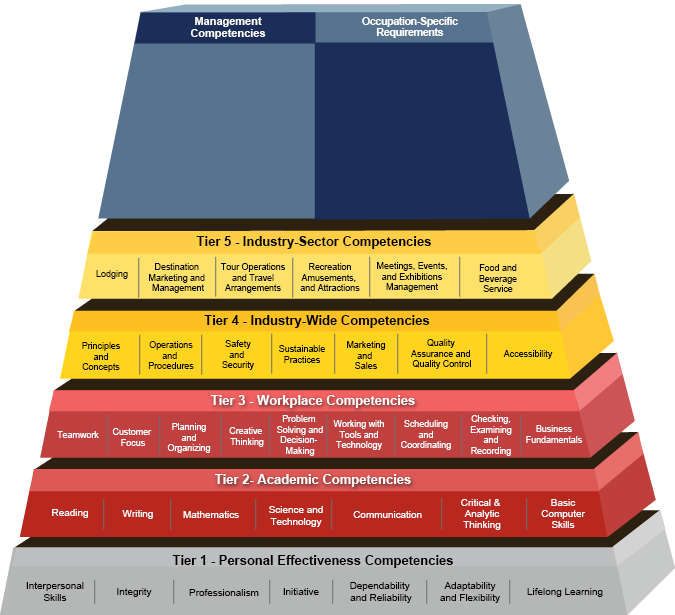
The Employment and Training Administration (ETA) has worked with the National Travel and Tourism Office of the Department of Commerce and with technical and subject matter experts from education, business, and industry to develop a comprehensive competency model for the Hospitality, Tourism, and Events industry. The model identifies the knowledge, skills, and abilities that provide a foundation for industry workers, as well as competencies specific to key sectors. While the model seeks to cover all workers in the industry, it is not intended that each worker possess all of the competencies listed. The model is rather a compilation of competencies that can be included as a basis for preparation in a Hospitality, Tourism, and Events occupation.

In 2025, the International Association of Exhibitions and Events (IAEE), the Events Industry Council, and Freeman worked with their industry partners to update the model to accommodate changing skill requirements. This update is the culmination of a multi-year competency profile project involving more than 1,000 Certified Meeting Professionals (CMP) and CMP Fellow volunteer SMEs who have provided insights and support to revise the CMP International Standards.

In 2025, the foundational tiers of the model were updated to align with changes in the Building Blocks Model. For more information, download the Summary of Changes.


Scroll down to view the industry model selected. OR Click on the left menu bar to select another model.

Download the industry model and worksheets in several formats  It is an image of png format for download button

Hospitality, Tourism, and Events Competency Model


Hospitality, Tourism, and Events Building Blocks Pyramid

<strong>1.1 Interpersonal Skills</strong> Displaying the skills to work effectively with others. <strong>1.2 Integrity</strong> Displaying strong moral principles and work ethic. <strong>1.3 Professionalism</strong> Maintaining a professional presence. <strong>1.4 Initiative</strong> Demonstrating a commitment to effective job performance by taking action on one’s own and following through to get the job done. <strong>1.5 Dependability and Reliability</strong> Displaying responsible behaviors at work. <strong>1.6 Adaptability and Flexibility</strong> Displaying the capability to adapt to new, different, or changing requirements. <strong>1.7 Lifelong Learning</strong> Demonstrating a commitment to self-development and improvement of knowledge and skills. <strong>2.1 Reading</strong> Understanding written sentences, paragraphs, and figures in work-related documents on paper, on computers, or adaptive devices. <strong>2.2 Writing</strong> Using standard business English to compile information and prepare written documents on paper, computers, or adaptive devices. <strong>2.3 Mathematics</strong> Uses mathematics to solve problems. <strong>2.4 Science and Technology</strong> Using scientific rules and methods to express ideas and solve problems on paper, on computers, or on adaptive devices. <strong>2.5 Communication</strong> Listening, speaking, and signaling so others can understand using a variety of methods, including hearing, speech, American Sign Language, instant messaging, text-to-speech devices, etc. <strong>2.6 Critical and Analytic Thinking</strong> Using logical thought processes to analyze information and draw conclusions. <strong>2.7 Basic Computer Skills</strong> Using information technology and related applications, including adaptive devices and software, to convey and retrieve information. <strong>3.1 Teamwork</strong> Working cooperatively with others to complete work assignments. <strong>3.2 Customer Focus</strong> Efficiently and effectively addressing the needs of clients/customers. <strong>3.3 Planning and Organizing</strong> Planning and prioritizing work to manage time effectively and accomplish assigned tasks. <strong>3.4 Creative Thinking</strong> Generating innovative and creative solutions. <strong>3.5 Problem Solving and Decision-Making</strong> Generating, evaluating, and implementing solutions to problems. <strong>3.6 Working with Tools and Technology</strong> Selecting, using, and maintaining tools and technology to facilitate work activity (with accommodation, when necessary). <strong>3.7 Scheduling and Coordinating</strong> Making arrangements that fulfill all requirements as efficiently and economically as possible. <strong>3.8 Checking, Examining, and Recording</strong> Entering, transcribing, recording, storing, or maintaining information in written or electronic/digital format. <strong>3.9 Business Fundamentals</strong> Using information on basic business principles, trends, and economics. <strong>4.1 Principles and Concepts</strong> The fundamental principles and concepts related to the hospitality, tourism, and events establishments, organizations, and activities. <strong>4.2 Operations and Procedures</strong> Delivering, monitoring, controlling, and improving services common across the hospitality, tourism, and events sectors. <strong>4.3 Safety and Security</strong> Provide a safe and secure environment for hospitality, tourism, and events customers, attendees, and workers. <strong>4.4 Sustainable Practices</strong> Minimize the environmental, social, economic, and cultural impact of the organization, establishment, or event. <strong>4.5 Marketing and Sales</strong> Promote and sell industry services and products (events). <strong>4.6 Quality Assurance and Quality Control</strong> Ensure materials, processes, services, and products meet quality specifications and customer expectations. <strong>4.7 Accessibility</strong> Ensure that all services offered by the hospitality establishment are accessible to all people, including people with disabilities. <strong>5.1 Lodging</strong> The operation of lodging facilities and the care of guests who use these facilities, either through direct guest contact or the provision of background services that enhance the guest experience. <strong>5.2 Destination Marketing and Management</strong> The development of a travel and tourism strategy for a specific destination that aids the long-term development of its communities. <strong>5.3 Tour Operations and Travel Arrangements</strong> The development, research, packaging, promotion, and delivery of a traveler’s experiences. <strong>5.4 Recreation, Amusements, and Attractions</strong> The operation of establishments or facilities that provide services to meet varied cultural, entertainment, and recreational interests. <strong>5.5 Meetings, Events, and Exhibitions Management</strong> The planning, implementation, and evaluation of gatherings such as conventions, cultural events, political events, and trade shows. Click here to go to Competency Model Clearinghouse - Food and Beverage Service Industry Competency Model Click here to search for O*NET Occupational Competencies Profiles