In this section, list your past and current jobs, core responsibilities, and accomplishments that relate to your job goal. Your work history is important to employers. Make it very easy for them to find the qualifications and skills that relate to the position they're hiring for.
If you have limited work experience, it's fine to include all your past jobs - just emphasize the skills, tasks, and outcomes that are most relevant to the target job. If you have a longer work history, include or emphasize only the jobs that add the most value to your application, from the past 12-15 years. For unrelated jobs that fill in your work history, include a brief description.
For each job, list your job title, name of the organization you worked for, city and state of the organization, and employment dates. Ideally, include the day, month, and year that you began and ended each job, since resume scanning systems often filter for specific length of time employed and length of specific types of experience. For example:
Registered Nurse, City Hospital, Kansas City, KS 09.04.2018 - 12.06.2025
How to write dynamic work descriptions
For each job, aim to write about 5-8 bullet points that describe important tasks and accomplishments. Don't include every task unless you need to fill space. Try to keep each bullet point to only one or two lines in length.
Describe your work experience using keywords from the job posting, especially terms the employer uses for required or desired skills and experience.
Use specifics. Don't just say what you did; include the context of your work, why you did it, for whom, and what the outcome was. That's what gets noticed. Ask yourself "What happened as a result of my doing this task or part of the job?"
- Include numbers. How many people were served/supervised/informed/helped?
- Include dollar amounts where possible. How much in sales, budget savings, increased earnings, reduced spending - did your work influence?
- Include percentages and other data. What impact did your work have on others? How were people people or served? What changed as a result of your work? What was improved or enhanced, and by how much? How did the product or service change? Did customer service or reviews improve?
- Include recognition or reviews. What did customers, co-workers, supervisors, or top leadership say about your work or your team's accomplishments?
Some examples:
- Developed and led a wide variety of skits, songs, and lessons for 50+ campers to create a rich summer camp experience.
- Analyzed more than X blood samples daily with precise standards for patient identification, promptness and test integrity, resulting in outstanding reviews.
- Promoted quickly at machine shop; kept work station pristinely clean, made consistent, high-quality welds for variety of projects.
General tips
- If you have gaps in your work history, check out a resume format that emphasizes your skills.
- Right justify your work dates to make it easy to find them.
- For consistency, be sure your work experience relates to your Summary and Skills sections, and that it matches your LinkedIn profile.
- If needed, include one line to describe the company or organization from past jobs so the context of your work is clearer.
- Have little experience in the job you're applying for? Emphasize the transferable skills you developed in past jobs that relate to your new job goal.
Check out how Maya described her work history, which she titled Professional Experience:
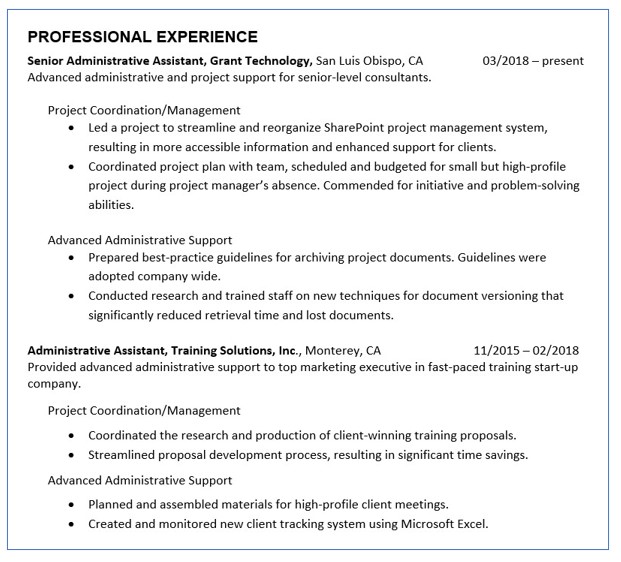
There are several points to note about this section:
- For a resume format, Maya chose a combination style (chronological with functional headings). This works well because:
- She has a steady work history, with no break between jobs. Both of her jobs are administrative assistant positions.
- The transition from administrative assistant to project coordinator is a logical progression, not a major career change.
- The headings (Project Coordination/Management and Advanced Administrative Support) let her highlight advanced projects that help qualify her for a coordinator position.
- For achievements in each job, she uses bulleted text and keeps the general job descriptions brief.
- She uses the same set of task headings for the two jobs. This reinforces the headings, and helps the reader scan quickly.
- To emphasize her current position, she gives more detail, but keeps both job descriptions at about two lines.

